
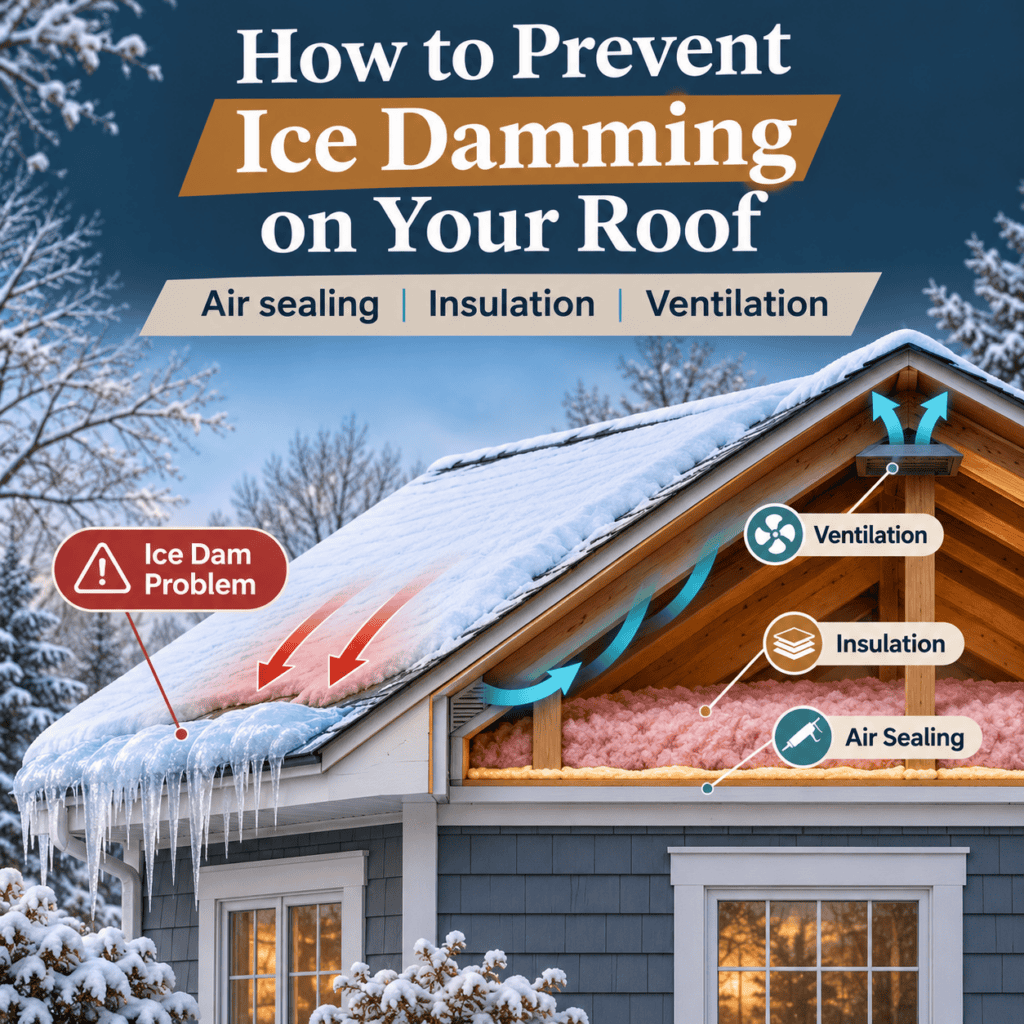
The best way to prevent ice damming is to seal air leaks between your home and attic, install adequate attic insulation, and maintain ventilation appropriate to your roof design. These improvements reduce the heat escaping through your roof, helping prevent the uneven snowmelt and refreezing that create ice dams.
Clearing roof snow and keeping gutters unobstructed can also help during winter. However, these measures do not address the underlying heat loss that often causes ice dams to return.
Understanding how ice dams form-and which prevention methods actually address their causes-can help you protect your roof from recurring winter damage.
What Causes Ice Dams to Form on a Roof?
Ice dams form when snow melts on a warmer section of a roof, flows toward the colder eaves, and refreezes into a ridge of ice that prevents additional meltwater from draining.
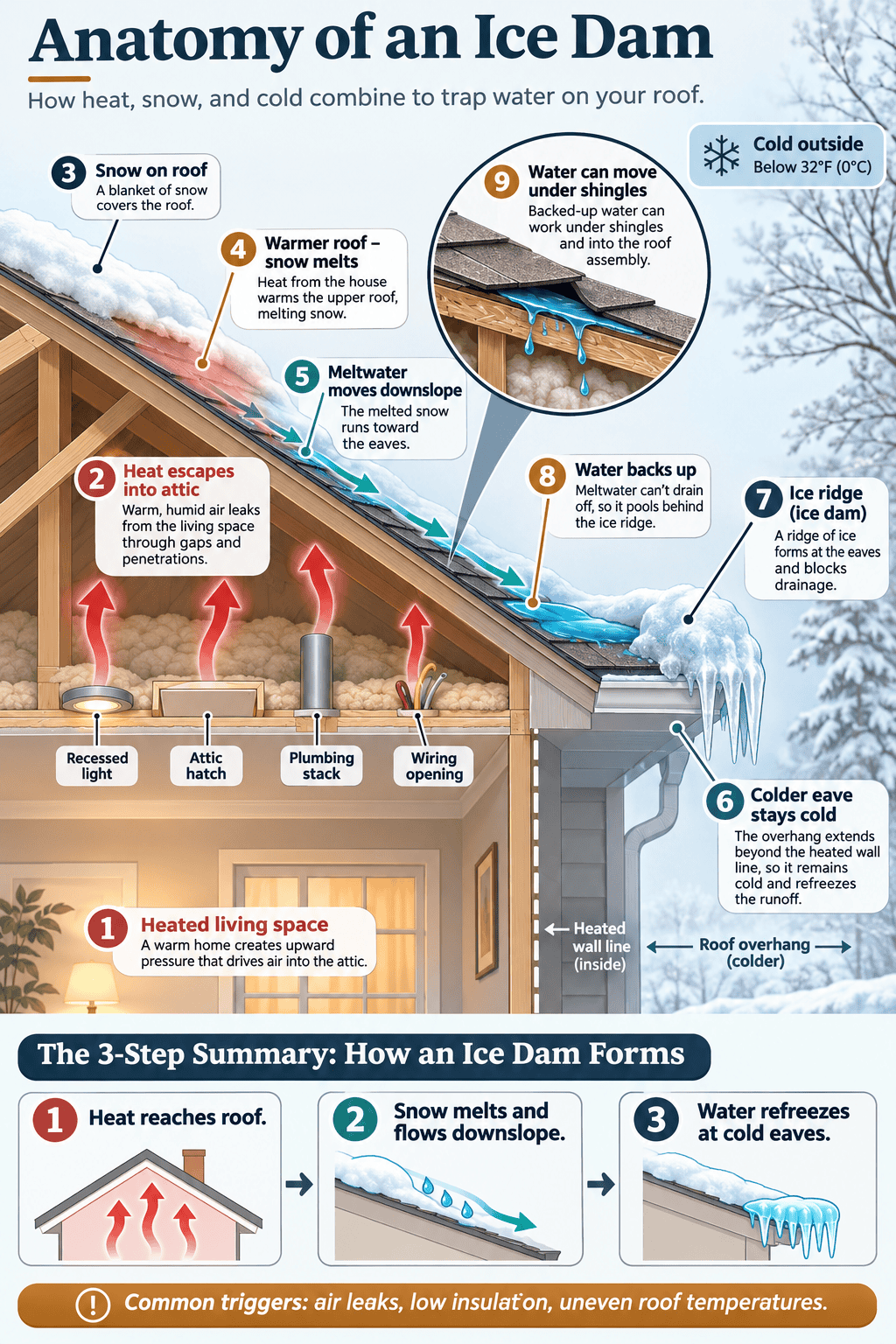
This happens when the roof surface has uneven temperatures. Heat escaping from the house can warm the roof deck beneath accumulated snow, even when outdoor temperatures remain below freezing.
As the snow melts, water travels down the roof until it reaches the overhang beyond the heated walls. Because this section typically stays colder, the water freezes again.
With continued melting and refreezing, ice accumulates along the roof edge. The growing ridge traps water behind it, where that water can work beneath shingles and leak into the attic, insulation, ceilings, or walls.
Several conditions can increase the likelihood of ice dam formation:
- Attic air leaks: Warm indoor air escapes through openings around plumbing, wiring, recessed lights, and attic access points.
- Insufficient insulation: Heat passes through the ceiling and warms the attic or roof deck.
- Inadequate ventilation: In a conventional vented attic, restricted airflow can contribute to uneven roof temperatures.
- Other attic heat sources: Leaky heating ducts, exhaust systems, and chimneys can warm specific roof areas.
- Complex roof construction: Valleys, dormers, skylights, and irregular framing can make continuous air sealing and insulation more difficult.
Ice dams are most common in cold climates where snow remains on roofs for extended periods. However, their formation depends on the combination of snow cover, roof temperatures, and freezing conditions-not simply how cold the outdoor air becomes.
How to Prevent Ice Damming for the Long Term
Long-term ice dam prevention focuses on keeping the roof surface consistently cold enough to limit snowmelt caused by heat escaping from the house. For a conventional unconditioned, vented attic, this generally means air sealing the ceiling, improving insulation, and maintaining appropriate attic ventilation.
These measures address different ways heat reaches the roof, so they work best as part of a coordinated approach.
1. Seal Air Leaks Between the Living Space and Attic
Air sealing is generally the first step in preventing heat loss that contributes to ice dams.
Warm air naturally rises and can escape into the attic through gaps in the ceiling. These openings often develop around attic hatches, plumbing pipes, electrical wiring, recessed lighting, and framing connections.
When heated indoor air enters an unconditioned attic, it can raise temperatures near the roof deck and cause snow to melt unevenly.
Sealing attic air leaks reduces the movement of warm indoor air into the attic, helping keep the roof deck cooler during freezing weather.
Professional air sealing involves identifying leakage paths and closing them with materials appropriate for each location. Depending on the opening, this may include sealants, rigid blocking, or expanding foam.
Openings around chimneys and furnace flues require special treatment because of high temperatures and fire-safety clearances. These areas may need metal flashing and heat-resistant sealants rather than ordinary spray foam.
Air sealing should generally be completed before additional insulation is installed. Otherwise, warm air can continue moving through gaps beneath the insulation.
2. Improve Attic Insulation to Reduce Heat Loss
Even with air leaks sealed, heat can pass through the ceiling by conduction. Insulation slows this heat movement, helping maintain the temperature difference between the heated living space and the attic.
In a conventional vented attic, insulation is generally installed along the attic floor, above the ceiling of the occupied rooms.
To help prevent ice dams, attic insulation should provide continuous coverage at a level appropriate for the local climate and building requirements, with particular attention to the areas above exterior walls.
Poorly insulated sections near the eaves can create warmer roof areas that encourage localized snowmelt.
Blown-in cellulose, fiberglass, and other approved insulation materials can provide effective thermal resistance when correctly installed. The appropriate material and insulation level depend on the existing construction and local energy requirements.
Simply adding insulation does not automatically resolve every ice dam problem. Air leakage, gaps in coverage, and other sources of attic heat can continue warming the roof even after insulation is upgraded.
For this reason, air sealing and insulation should be evaluated together rather than treated as separate solutions.
3. Maintain Proper Attic and Roof Ventilation
Ventilation helps regulate attic temperatures and remove accumulated moisture in roof assemblies designed to be vented.
In a typical vented attic, outside air enters through soffit vents near the roof edges and exits through vents higher on the roof. This airflow helps keep the underside of the roof closer to outdoor temperatures.
Insulation baffles may be needed near the eaves to prevent insulation from blocking the ventilation pathways.
Proper attic ventilation can help reduce ice dam formation, but ventilation alone cannot compensate for significant heat loss through an unsealed or poorly insulated ceiling.
Adding powered attic fans is not a routine ice dam prevention solution. In some homes, mechanical ventilation can create pressure differences and moisture problems.
Not every roof should use the same ventilation arrangement. Unvented roof assemblies require a different air, insulation, and moisture-control strategy.
Before altering roof ventilation, it is important to understand how the existing attic and roof assembly were designed to function.
4. Address Heating Ducts and Other Attic Heat Sources
Some ice dams occur because heat reaches the roof from specific locations rather than being distributed evenly throughout the attic.
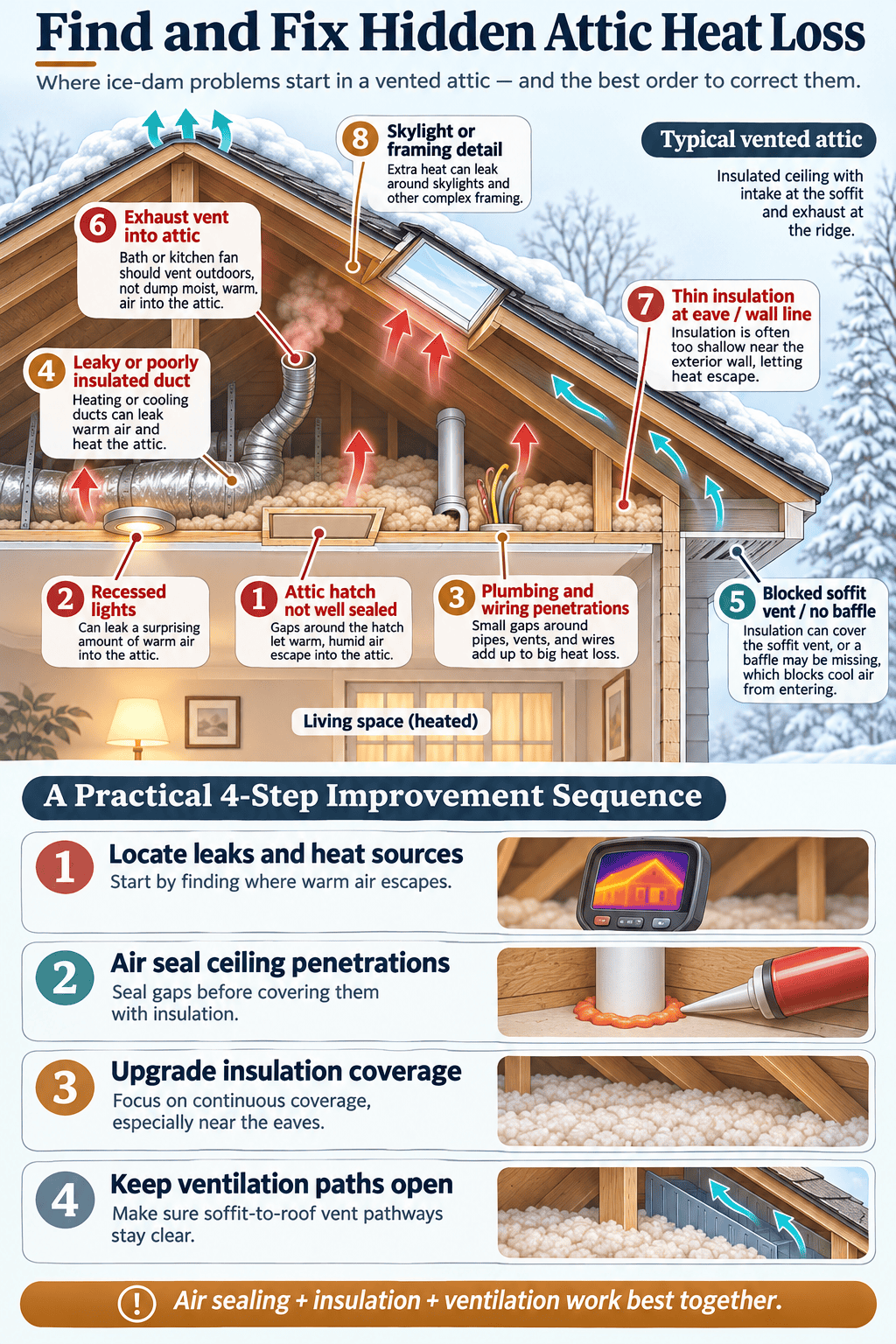
Leaky or inadequately insulated heating ducts can release warm air into unconditioned spaces. Recessed lights, attic access points, skylights, and complicated framing details may also create localized heat-loss problems.
Bathroom and kitchen exhaust systems should discharge outdoors through properly designed ducts rather than releasing warm, moist air into the attic.
Correcting these conditions can help reduce the temperature differences responsible for recurring ice dams.
Does Removing Snow From the Roof Prevent Ice Dams?
Removing accumulated roof snow can reduce the likelihood of ice dam formation because it removes the snow that would otherwise melt and refreeze. However, roof snow removal is a short-term preventive measure, not a permanent correction for attic heat loss.
A roof rake designed for snow removal may allow some snow near the eaves to be cleared while the operator remains on the ground.
Even so, snow removal requires caution. Roof rakes can damage shingles or other roofing materials if used improperly, and falling snow or ice can create injury hazards.
Avoid climbing onto snow-covered or icy roofs. Steep roofs, difficult-to-reach sections, and heavy snow accumulation may require professional assistance.
A properly sealed and insulated attic can also allow more snow to remain on the roof because less indoor heat reaches the roof deck. Roofs must therefore be capable of supporting expected snow loads. If a home’s structural capacity is uncertain, a qualified professional should evaluate it.
Can Cleaning Gutters Prevent Ice Damming?
Keeping gutters and downspouts clear helps meltwater drain away, but clean gutters cannot prevent ice dams caused by uneven roof temperatures.
Leaves, debris, and existing ice can obstruct drainage and make winter roof problems more difficult to manage.
Cleaning gutters before freezing weather is useful preventive maintenance. Downspouts should also remain unobstructed so water can drain away from the building.
However, ice dams can form directly on the roof above the gutters. When melting snow reaches a roof edge that remains below freezing, it can refreeze regardless of whether the gutter is clean.
Gutter maintenance is therefore a supporting measure, not a substitute for attic air sealing and insulation.
Do Roof Heating Cables and Ice-and-Water Shields Prevent Ice Dams?
Roof heating cables and ice-and-water protection membranes can help manage ice-related problems, but they perform different functions.
Roof Heating Cables
Roof heating cables can help maintain drainage channels through localized ice buildup, but they do not correct the heat loss that causes snow to melt unevenly.
These electrically powered systems are installed in selected roof-edge or gutter areas to reduce ice accumulation and allow some meltwater to drain.
Their effectiveness depends on proper product selection, installation, and operation. They also consume electricity and may require ongoing maintenance.
Heating cables can be useful in certain situations, but recurring ice dams should still prompt an assessment of the attic and roof assembly.
Ice-and-Water Protection Membranes
Ice-and-water protection membranes help reduce water intrusion when ice dams occur; they do not stop ice dams from forming.
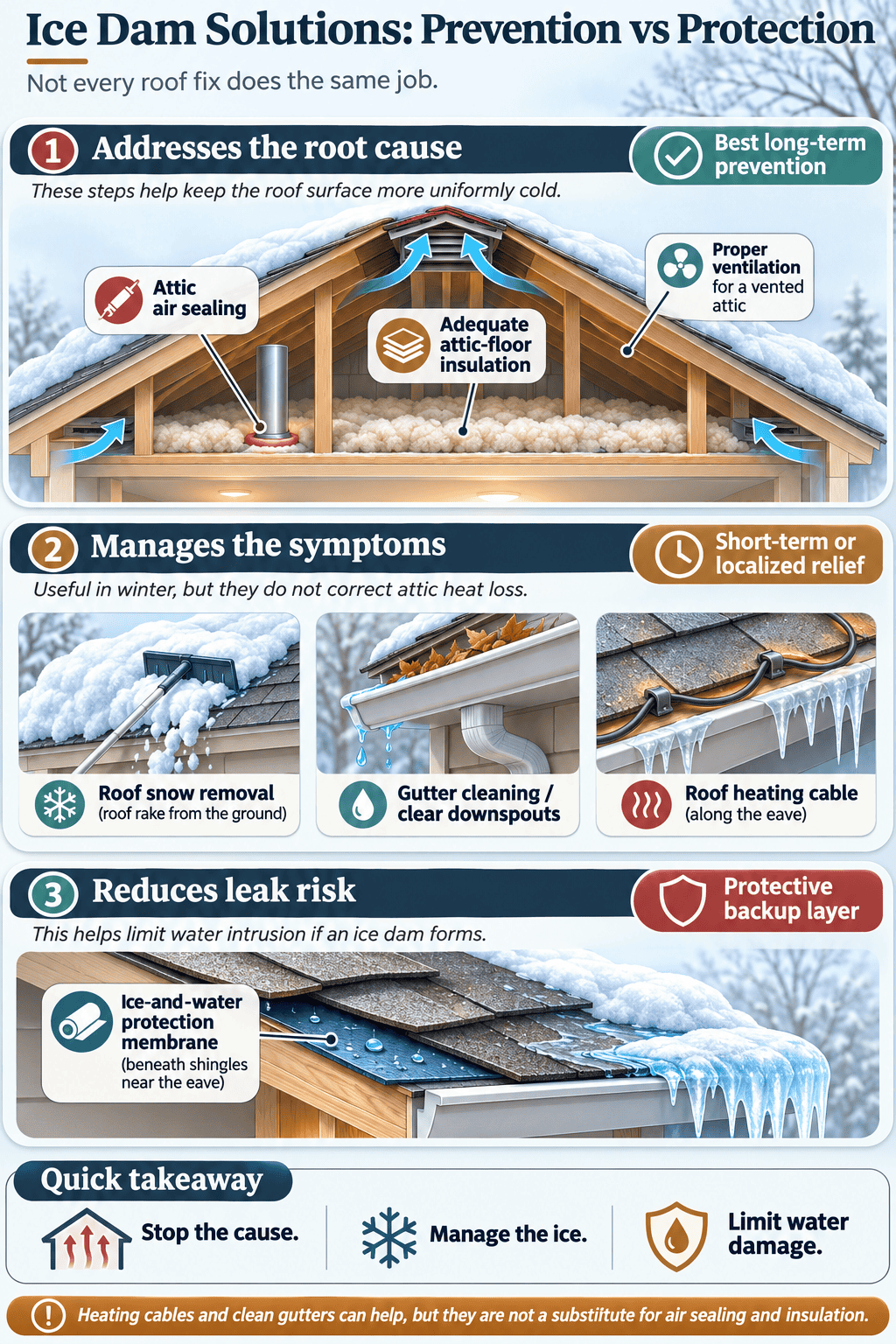
These self-adhering roofing underlayments are installed beneath the roof covering in areas vulnerable to backed-up meltwater.
If an ice dam traps water near the eaves, the membrane provides an additional layer of protection against leakage into the roof assembly.
Appropriate membrane coverage depends on the roof construction, climate, and applicable building requirements.
Unlike insulation and air sealing, a protective membrane addresses potential water damage rather than the temperature conditions responsible for ice dam formation.
What Should You Do if an Ice Dam Has Already Formed?
If an ice dam is already present, the immediate priority is preventing injury and limiting water damage. Permanent prevention measures can be addressed once the existing ice and any active leaks are under control.
Avoid striking or chopping ice with axes, picks, or other sharp tools. These methods can damage shingles and roofing materials while creating serious safety hazards.
Do not climb onto an icy roof or stand beneath large icicles or unstable snow buildup.
If water is entering the attic or living space, contact a qualified roofing or ice-dam removal professional. Appropriate removal methods depend on the roof conditions and severity of the buildup.
Water-damaged ceilings, insulation, and other materials should be dried, and the source of water intrusion should be addressed before permanent interior repairs are completed.
Removing an ice dam may resolve the immediate drainage problem, but it does not prevent another one from forming when similar weather conditions return.
Why Do Ice Dams Keep Coming Back?
Recurring ice dams often indicate unresolved heat loss, uneven insulation coverage, or problems with the attic and roof assembly. Addressing the ice itself without correcting these conditions can leave the underlying cause unchanged.
One useful warning sign is uneven snowmelt. If snow repeatedly disappears from one section of the roof while remaining elsewhere, heat may be reaching that section from below. However, sun exposure and roof geometry can also influence snowmelt patterns.
A professional attic assessment may examine:
- Air leakage through the ceiling and attic access points.
- Insulation thickness, coverage, and gaps.
- Ventilation pathways and blocked soffit openings.
- Heating ducts, exhaust systems, and other local heat sources.
- Roof framing and construction details that contribute to uneven temperatures.
Weatherization professionals may use blower door testing to evaluate air leakage and infrared imaging, under suitable conditions, to investigate areas of unusual heat loss.
The goal is to identify why the roof is warming unevenly and select improvements that address the actual cause.
Protect Your Roof With Better Attic Insulation and Air Sealing
Preventing ice dams starts with controlling how heat moves from the living space into the attic and roof. For many homes with conventional vented attics, sealing air leaks and installing sufficient insulation are the most important long-term improvements.
Proper ventilation, roof maintenance, and protective roofing materials can provide additional benefits, but they should support-not replace-an effective attic air and thermal barrier.