
First Defense Insulation installs open-cell and closed-cell spray foam insulation in Houston, TX, for attics, rooflines, walls, crawl spaces, and residential and commercial buildings. Spray foam insulates and helps seal air leaks in a single application, reducing unwanted heat transfer and airflow through the treated areas.
First Defense brings 35 years of combined insulation experience and offers free on-site comfort inspections and written estimates. We evaluate the area being insulated, moisture conditions, and the required R-value before recommending a foam type and thickness.
Call (713) 808-9853 for a free spray foam insulation estimate.
Spray foam insulation in Houston typically costs about $0.60–$1.60 per board foot for open-cell foam and $1.30–$3.10 per board foot for closed-cell foam, installed. The total cost depends on how much surface area needs insulation, the foam thickness, accessibility, and any preparation or insulation removal required.
A board foot is 1 square foot of surface area at 1 inch thick. To calculate board feet, multiply the surface area being sprayed in square feet by the foam thickness in inches. For example, spraying 1,000 square feet at a thickness of 3 inches requires 3,000 board feet of foam.
The floor area of a home is not the same as the area being sprayed. An attic roofline, wall cavities, and a crawl space each have different surface measurements and insulation requirements.
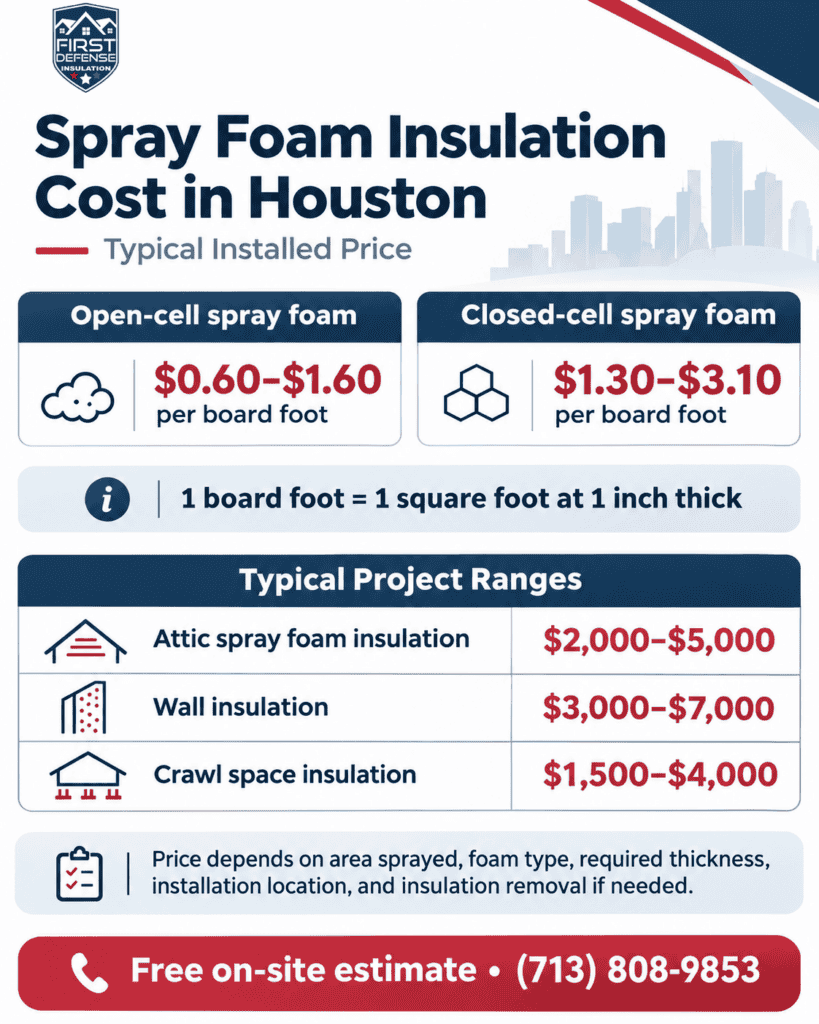
Estimated spray foam project costs in Houston range from $2,000–$5,000 for attics, $3,000–$7,000 for walls, and $1,500–$4,000 for crawl spaces. These are planning ranges, not flat-rate prices. The amount of foam and work required determines the final estimate.
A free on-site inspection provides a price based on the actual surfaces, installation depth, site access, and condition of the existing insulation.
The main factors affecting spray foam insulation cost are the size of the area being sprayed, open-cell versus closed-cell foam, required thickness, installation location, and whether existing insulation must be removed. Difficult access, extensive surface preparation, and special assembly requirements can also increase the cost.
A 2,000-square-foot home does not have one standard spray foam price. Insulating the attic roofline costs differently from insulating the exterior walls or crawl space because each job uses a different number of board feet.
Call (713) 808-9853 for a free on-site spray foam estimate in Houston.
Open-cell spray foam is generally less expensive and more vapor permeable, while closed-cell spray foam provides more R-value per inch and greater resistance to water-vapor movement. Both can insulate and air seal when installed at the thickness required for the specific product. The best choice depends on the building assembly, available space, and moisture-control needs.
Open-cell spray foam is a soft, lower-density insulation that typically provides R-3.5–R-3.8 per inch. It expands into irregular spaces, helps reduce air leakage, and can absorb sound.
Open-cell spray foam offers:
Open-cell foam is commonly used in wall cavities and suitable above-grade assemblies. Whether it belongs in a particular roof assembly depends on the roof's moisture-control and drying design.
Closed-cell spray foam is a dense, rigid insulation that typically provides R-5–R-7 per inch. It delivers higher thermal resistance in less space and slows water-vapor movement more effectively than open-cell foam.
Closed-cell spray foam offers:
Closed-cell foam is often considered where insulation depth is limited or a building assembly needs additional vapor resistance. The complete assembly must still be designed to manage moisture and allow appropriate drying.
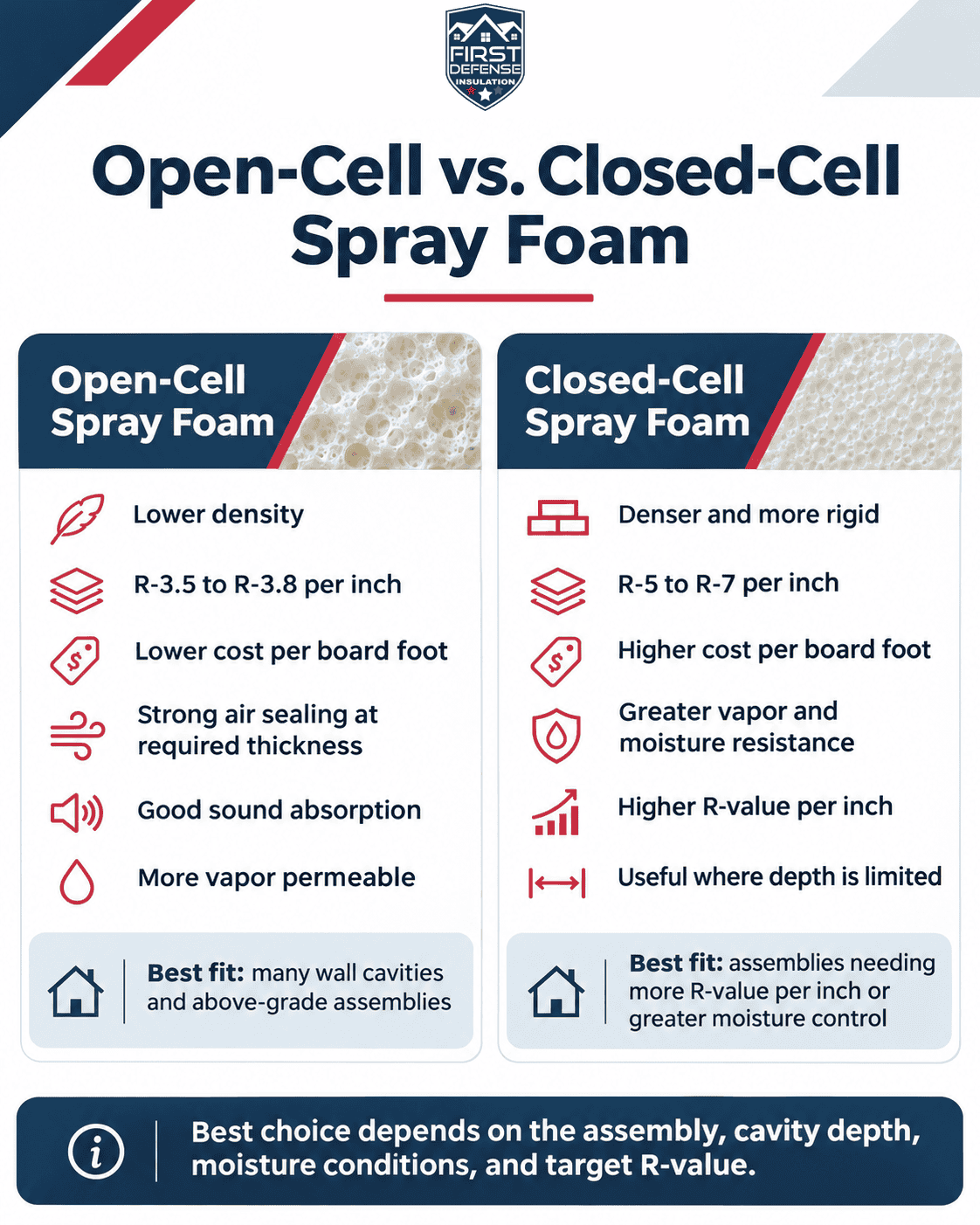
First Defense recommends open-cell or closed-cell foam based on the application, required R-value, cavity depth, moisture conditions, and the selected product’s installation requirements. Neither type is automatically the right answer for every Houston attic, wall, or crawl space.
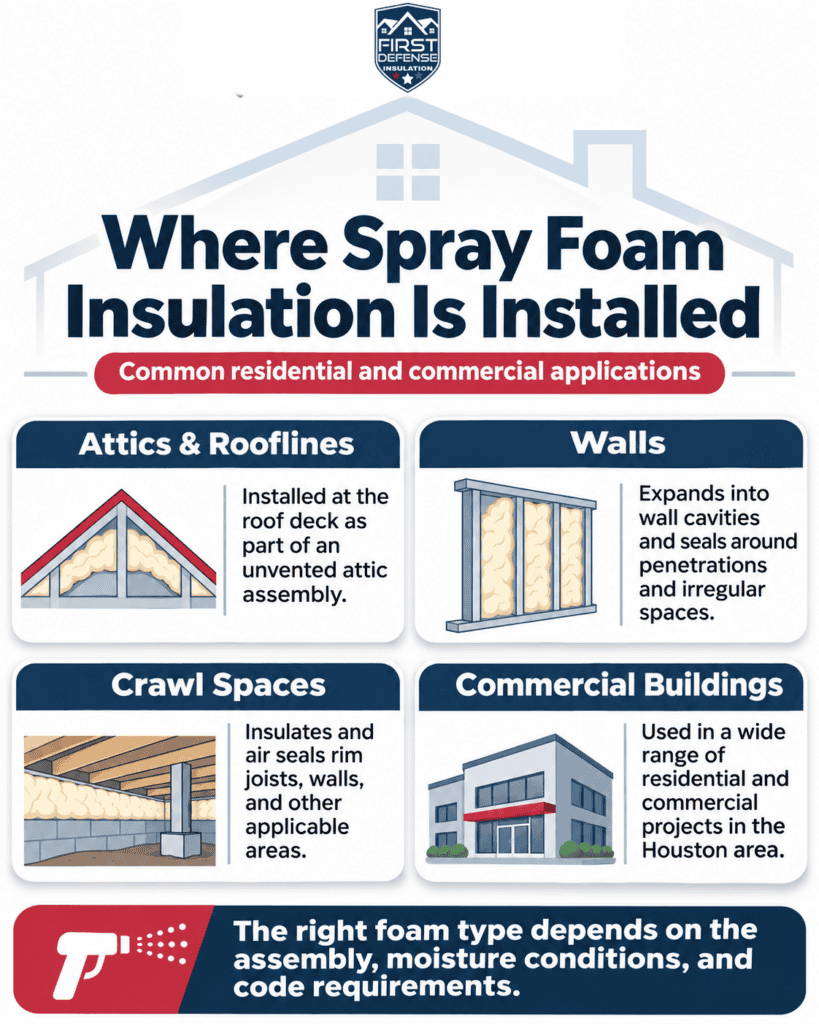
Spray foam insulation can be installed in attics, rooflines, wall cavities, crawl spaces, and appropriate commercial building assemblies. It is applied to accessible surfaces and expands to fill gaps and irregular spaces around framing.
Spray foam at the underside of a roof deck can form part of an insulated, unvented attic assembly. Moving the insulation layer to the roofline can bring attic ductwork and equipment inside the conditioned building envelope when the roof and air-control system are designed for that purpose.
Foam type, thickness, and moisture-control details are selected for the roof assembly. First Defense also provides attic insulation services for homes where a different approach is more suitable.
Spray foam fills accessible wall cavities and helps seal around framing, wiring, and other penetrations. Open-cell and closed-cell foam can both be used, depending on the wall's required R-value, available depth, and moisture-control design.
In finished walls, conventional two-component spray foam generally requires access to the cavities. It is not the same product as injection foam installed through small holes.
Spray foam can insulate and air seal crawl-space walls, rim joists, and other suitable surfaces. Moisture problems must be addressed before foam is applied. Standing water, mold, and damaged insulation may require drainage, removal, remediation, or encapsulation as part of the project.
First Defense also provides crawl space insulation and moisture-control services in the Houston area.
First Defense provides spray foam insulation for residential and commercial projects in the Houston area. Commercial installations are planned around the building's use, surface access, insulation requirements, and applicable fire-protection rules.
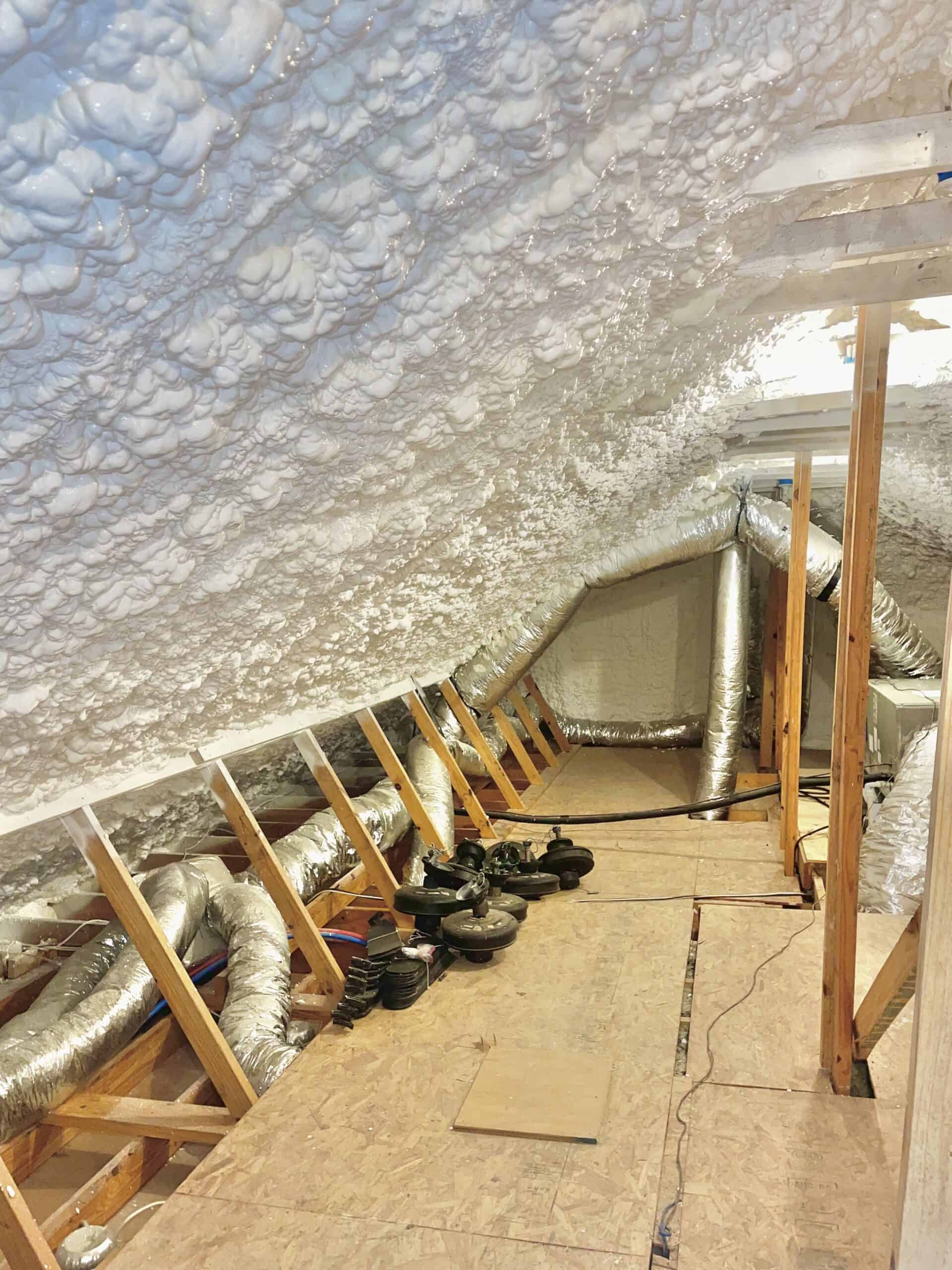
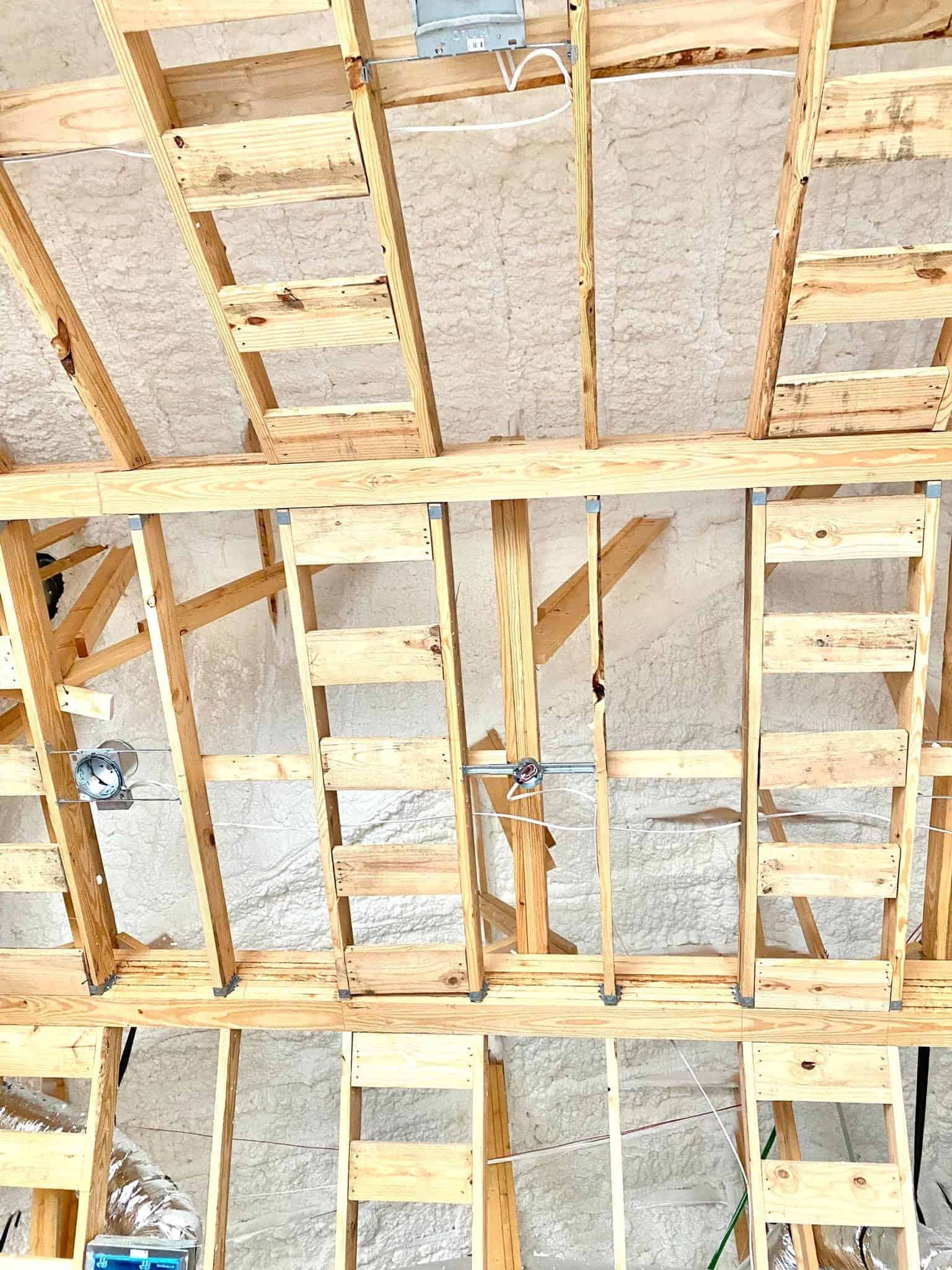
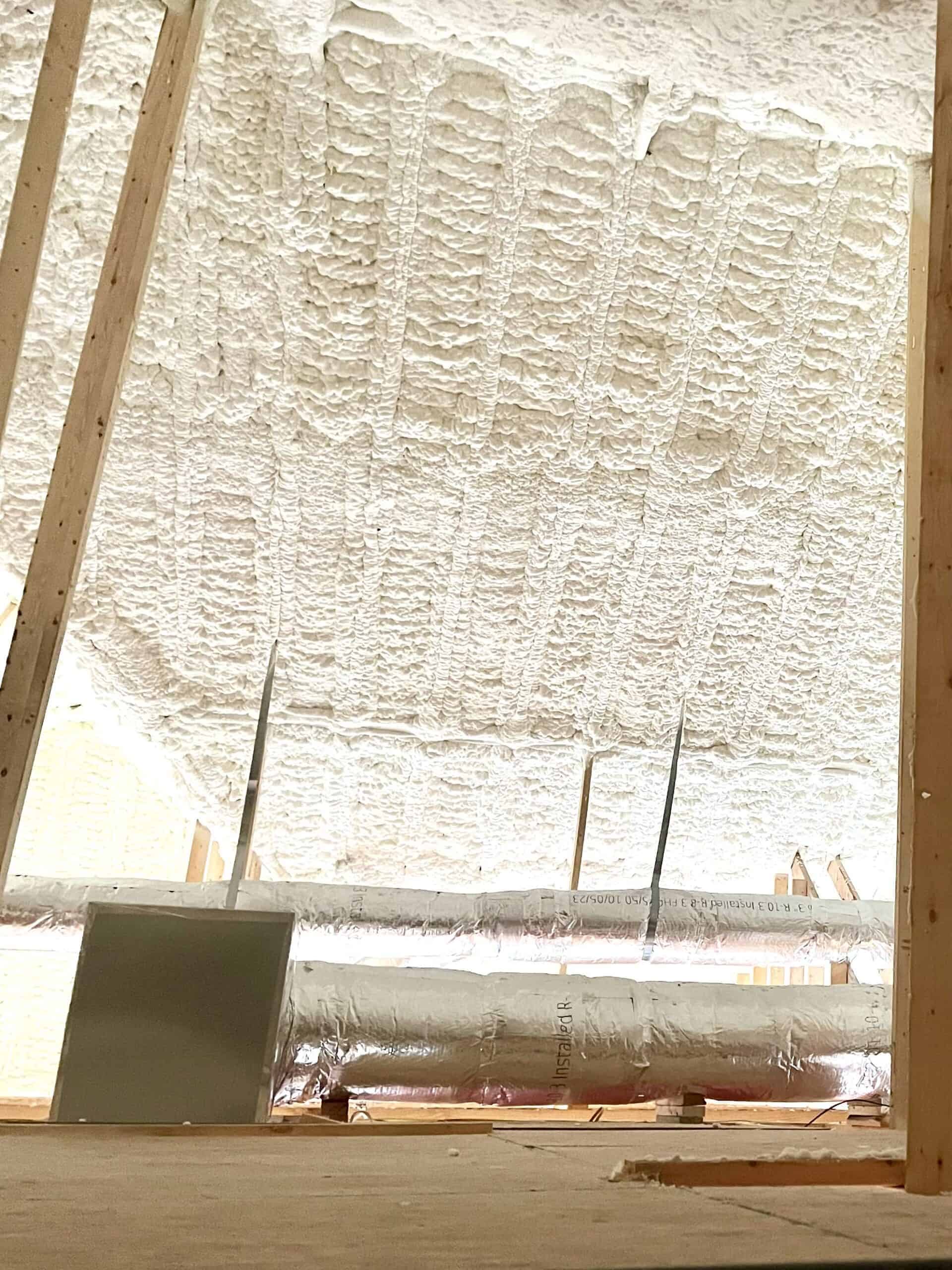
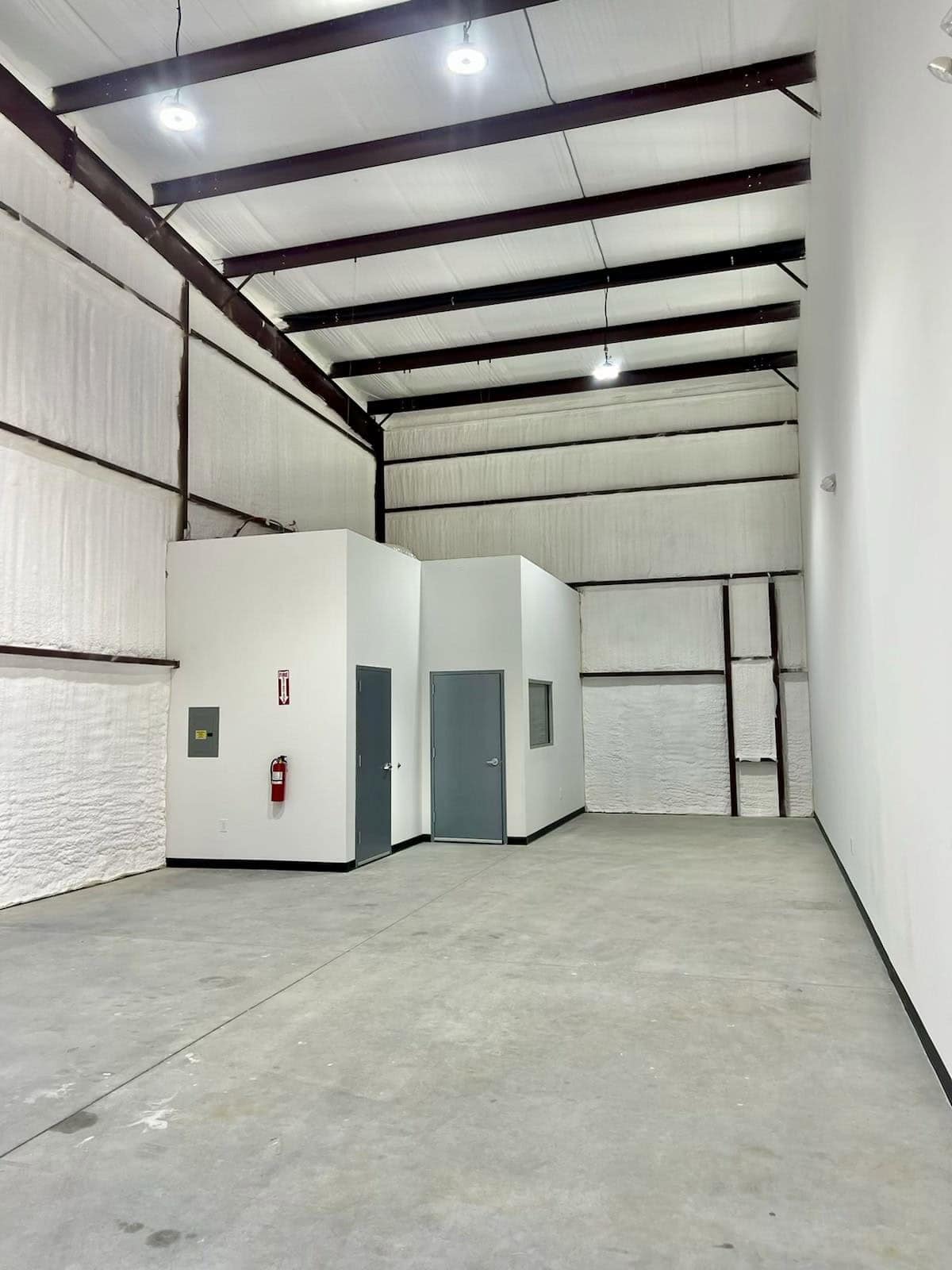
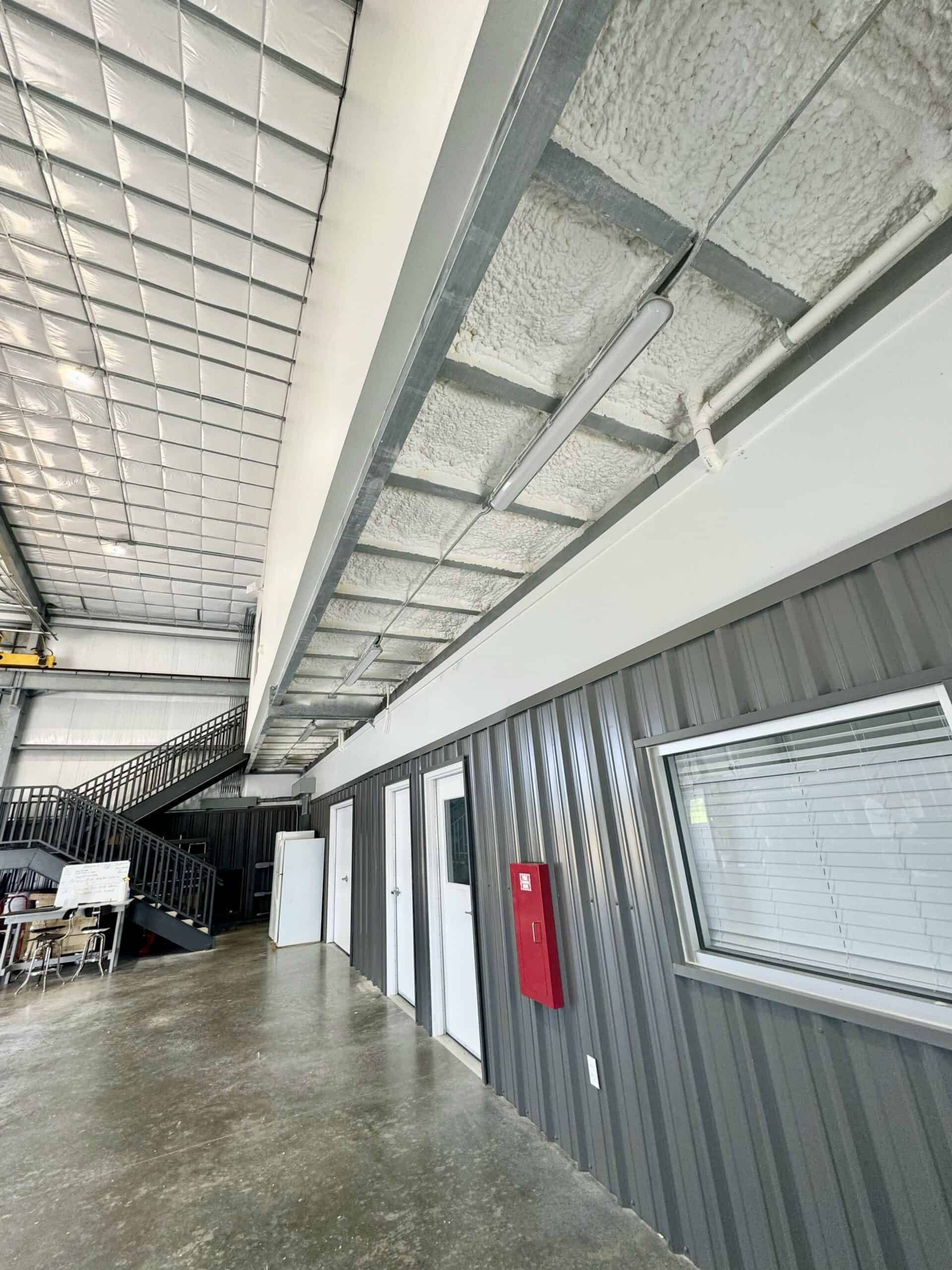
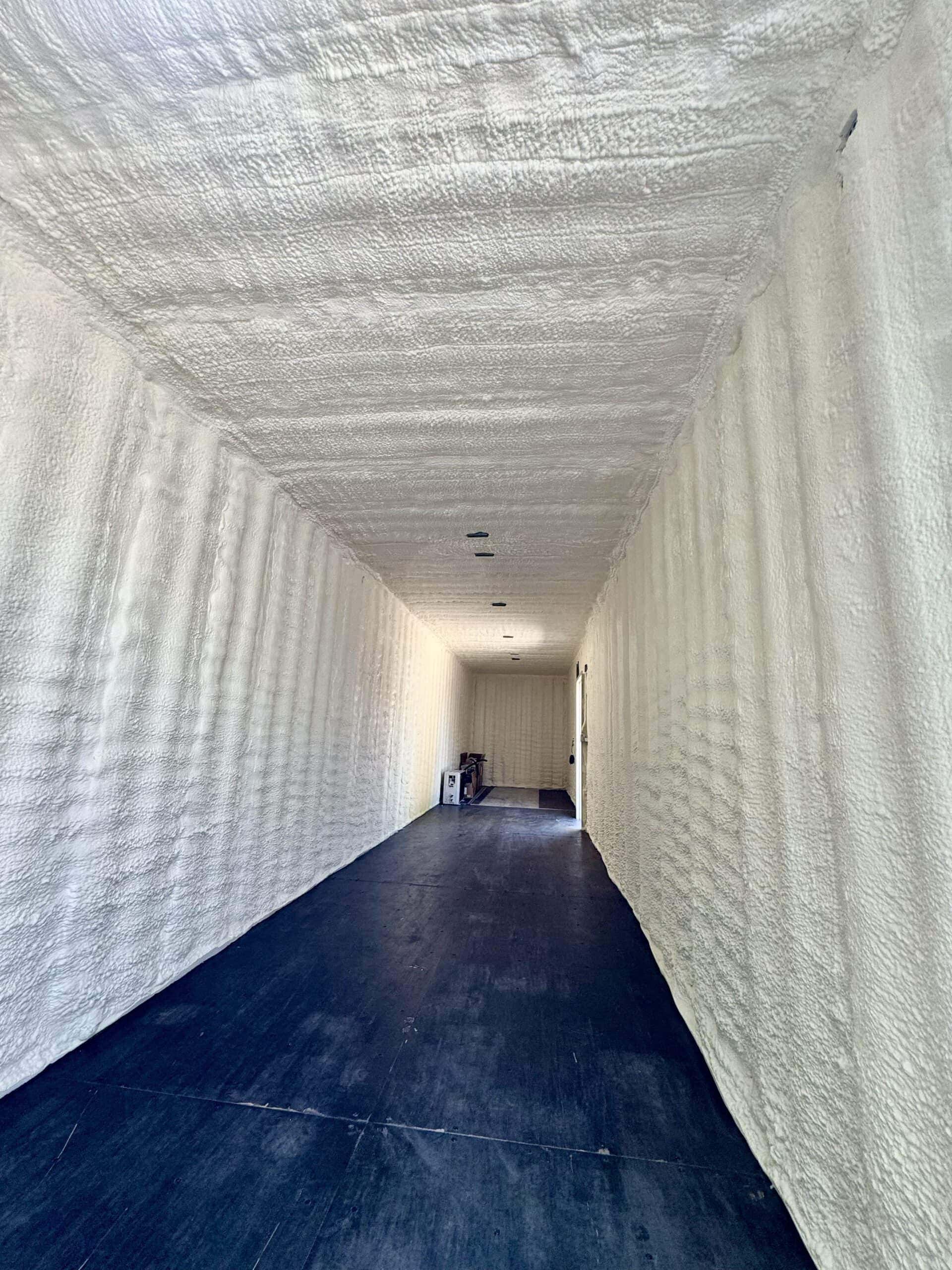
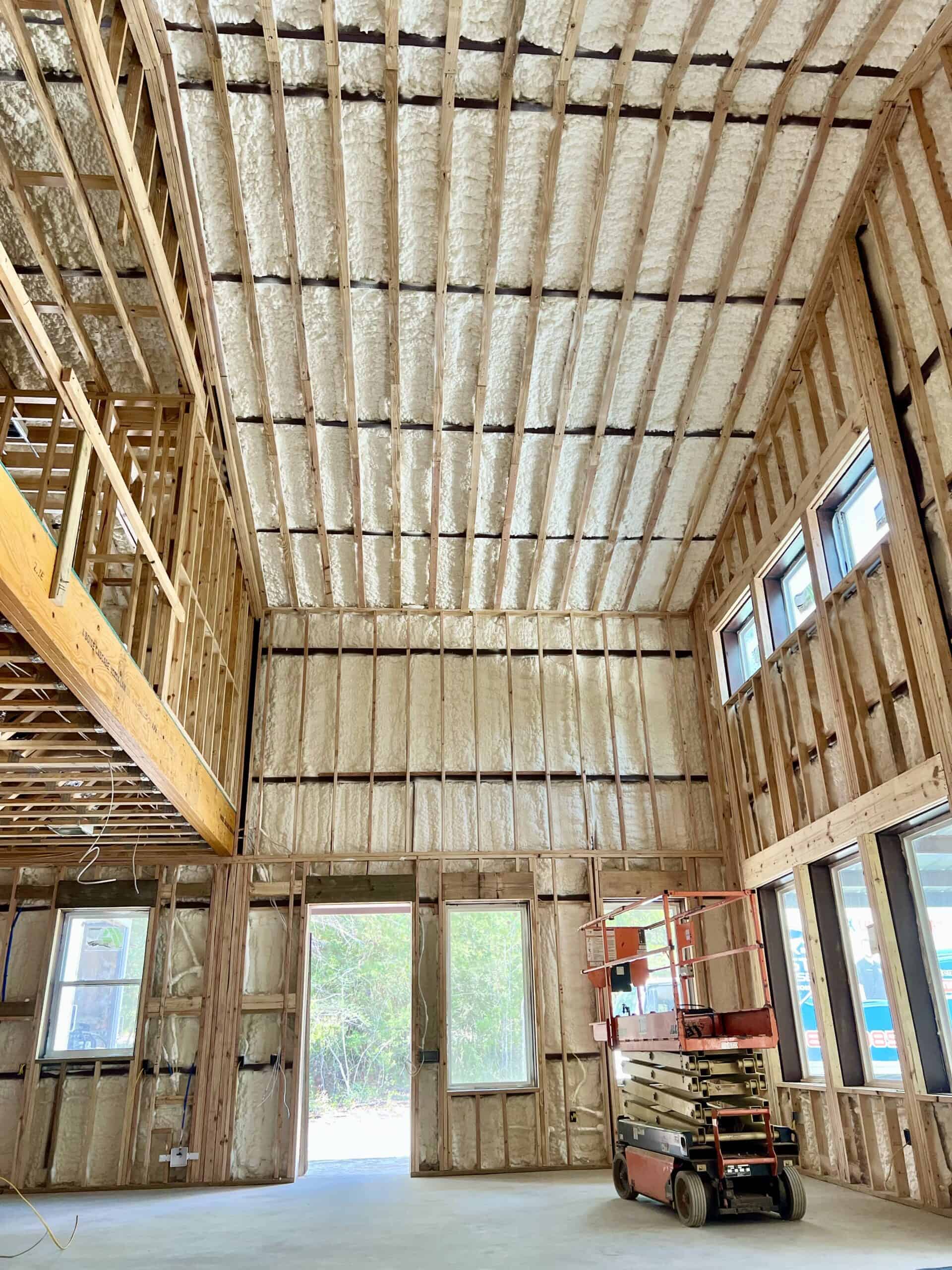
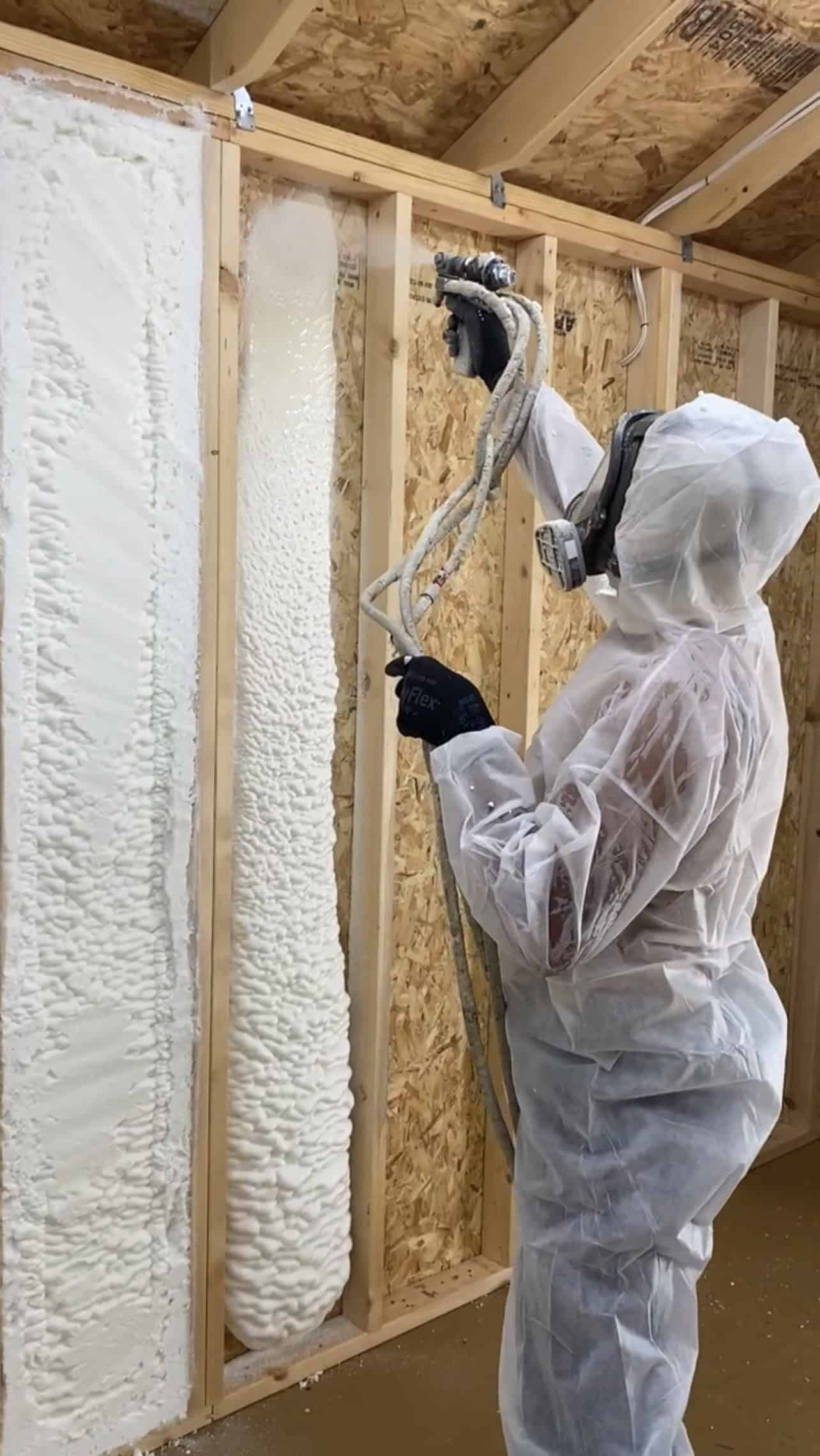
Professional spray foam installation includes inspection, a written estimate, surface preparation, foam application, and inspection of the finished coverage. Depending on the project, old insulation may need to be removed and additional fire-protection materials may be required.
First Defense measures the surfaces to be insulated, checks existing insulation and moisture conditions, and evaluates whether open-cell or closed-cell foam is the right fit.
The estimate identifies the installation area, foam type, intended thickness, any required insulation removal or preparation, and the project price before work begins.
Crews prepare suitable surfaces, protect areas that should not receive foam, and establish the ventilation and work-area controls required for the foam product. Existing leaks and moisture problems are addressed before spraying.
Wet, contaminated, or damaged insulation is removed when necessary. Existing materials are also removed where they prevent spray foam from bonding to the intended surface.
Specialized equipment mixes two liquid components at the spray gun. The mixture expands after application, adheres to suitable surfaces, and cures into an insulating layer. Installers follow the product's limits for application thickness, temperature, and the number of passes.
An approved thermal or ignition barrier is installed where required by the foam product, building assembly, and applicable code.
The crew checks coverage and addresses visible gaps or irregularities. Occupants remain outside the application area until the installed product's required exclusion period and ventilation procedures are complete.
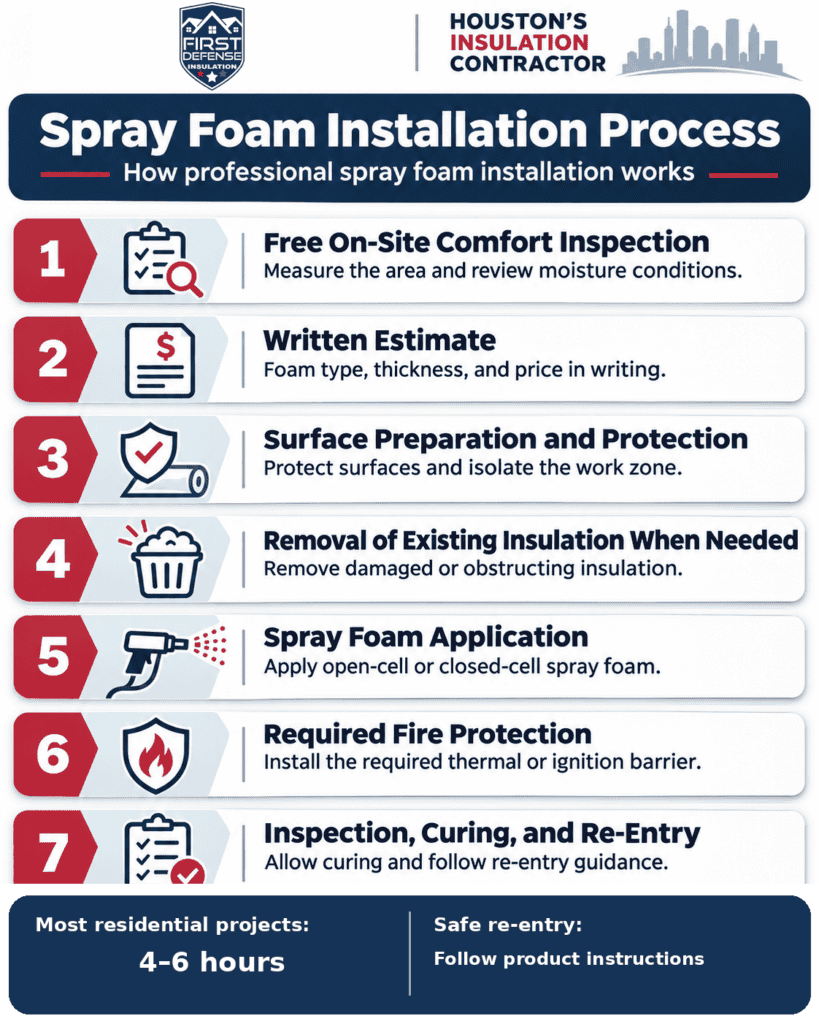
Many residential insulation projects are completed in one day, often within 4–6 hours. Spray foam installations with large surface areas, difficult access, extensive removal, or additional protective work can take longer.
Installation time is not the same as safe re-entry time. The foam may be installed in a single day while occupants still need to remain outside the treated area during curing and ventilation. Re-entry follows the manufacturer’s instructions for the specific foam used.
Spray foam insulation can be used safely when the correct product is installed under appropriate work-area controls, allowed to cure as directed, and protected against fire where the building code requires it. Chemical exposure during installation and fire protection after installation are separate considerations.
Uncured spray polyurethane foam contains reactive chemicals, including isocyanates, that can irritate the eyes, skin, and respiratory system and can cause sensitization. Professional crews use suitable protective equipment, ventilation, and exposure controls.
Unprotected workers and occupants must stay out of the spray area during installation and the required exclusion period. Properly cured foam differs from its liquid components, but incorrect mixing or inadequate curing can create problems.
You can return to the treated area after the manufacturer-specified re-entry period has passed and the required ventilation is complete. Some professional two-component foam products specify approximately 24 hours, but there is no universal waiting period for every foam system. The installer provides the instructions that apply to the product used in your home.
Spray foam often requires an approved thermal or ignition barrier, depending on where it is installed and how the space is used. A common thermal barrier in occupied interior spaces is 1/2-inch gypsum wallboard. Certain attics, crawl spaces, and tested foam assemblies have different approved protection requirements.
The installation must follow the locally applicable building code and the foam product's tested assembly requirements. Spray foam itself does not replace the fire-protection materials required for the job.
Spray foam’s main advantage is that it can provide insulation and air sealing in the same layer. Fiberglass and cellulose also provide effective thermal insulation, but air leaks typically need to be sealed separately before or during installation. Spray foam usually has a higher initial cost.
Spray foam is not automatically the best choice for every Houston home. If an attic floor mainly needs additional R-value, blown-in insulation with separate air sealing may deliver the required performance at a lower initial cost.
First Defense installs both open-cell and closed-cell spray foam and offers free on-site comfort inspections, written estimates, and 35 years of combined insulation experience. The team can evaluate insulation needs and related removal work as part of the same project.
The goal is to recommend the insulation method and thickness that fit the property, rather than quoting a foam type without evaluating the building.
First Defense provides spray foam insulation in Houston, Katy, Cypress, Spring, Humble, Magnolia, The Woodlands, and Conroe. Homeowners and commercial property owners throughout these communities can request a free on-site evaluation and estimate.
Call (713) 808-9853 to schedule spray foam insulation service in the Houston area.
Open-cell spray foam typically costs $0.60–$1.60 per board foot installed; closed-cell spray foam typically costs $1.30–$3.10 per board foot installed. Total project cost depends on sprayed area, thickness, access, and preparation.
A 2,000-square-foot home’s floor area is not enough to calculate an accurate spray foam price. The estimate depends on which surfaces are sprayed, their measured square footage, the foam type, and the required thickness. One board foot covers 1 square foot at 1 inch thick.
Open-cell foam generally costs less and is more vapor permeable; closed-cell foam provides higher R-value per inch and greater vapor resistance. The better choice depends on the attic, wall, or crawl-space assembly and its moisture-control needs.
The main disadvantages are higher upfront cost, professional installation requirements, chemical-exposure precautions during application, and more difficult removal if the building later needs major repairs. Incorrect application can also affect curing and insulation performance.
Spray foam needs a suitable surface to bond to, so existing insulation must be removed where it blocks the intended spray area. Wet, damaged, or contaminated insulation must also be addressed. Insulation in unaffected areas may remain when the assembly allows it.
Many residential insulation projects are completed in a single day, often within 4–6 hours. Larger or more complicated spray foam jobs take longer, and safe re-entry follows a separate product-specific schedule.
Return only after the foam manufacturer’s required re-entry period and ventilation steps have been completed. Some products specify about 24 hours, but the correct time depends on the foam system used.
Often, yes. Approved thermal barriers are commonly required between foam plastic and occupied spaces. Certain attics, crawl spaces, and tested assemblies qualify for different fire-protection methods under applicable codes.
First Defense Insulation provides free on-site evaluations and written estimates for open-cell and closed-cell spray foam insulation in Houston. We inspect the application area, explain the recommended foam type and thickness, and identify any preparation needed before giving you a project price.
Call (713) 808-9853 or request a free on-site comfort inspection today.